
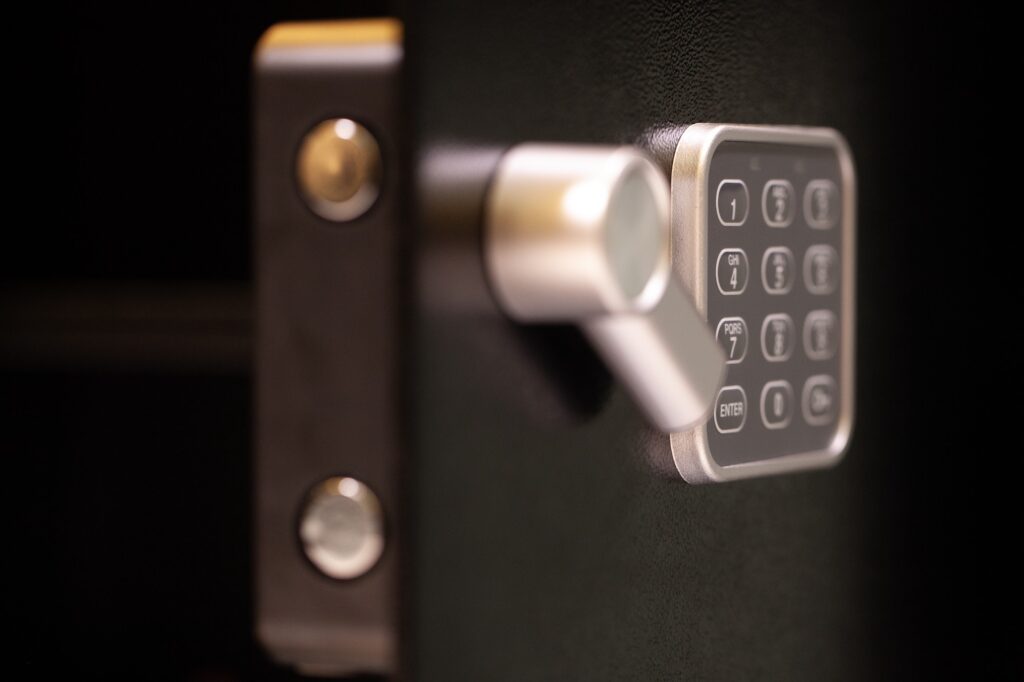
Electronic safes provide convenient access to cash, jewelry, documents, business records, and other valuables without requiring a traditional combination dial. A user enters a code through an electronic keypad, allowing the safe to open quickly while remaining locked against unauthorized access.
However, choosing a safe based only on its keypad, size, or advertised features can lead to inadequate protection. Before purchasing and installing one, consider its burglary resistance, fire rating, construction, anchoring method, power supply, backup-access design, capacity, placement, warranty, and intended use.
A professional locksmith can help determine whether the safe is appropriate for your security needs and whether it should complement other measures such as high-security locks, smart locks, deadbolt locks, or an access control system.
How Do Electronic Safes Work?
An electronic safe typically uses a keypad connected to an internal locking mechanism. When the correct code is entered, the mechanism releases the safe’s bolts so the door can be opened.
Depending on the model, an electronic safe may offer:
- One or more user codes
- A master or administrator code
- Time-delay opening
- Lockout after repeated incorrect attempts
- An audit trail
- Low-battery warnings
- An interior light
- Biometric access
- Smartphone connectivity
- A mechanical override key
- External emergency power contacts
- Tamper alerts
These features can improve convenience, but they do not automatically make the safe resistant to physical attacks. The strength of the door, body, hinges, bolts, anchoring system, and surrounding structure remains essential.
Electronic Safe vs. Mechanical Safe
Electronic and mechanical safes can both provide dependable protection when they are appropriately rated, correctly installed, and properly maintained.
| Electronic safe | Mechanical safe |
|---|---|
| Opens with a digital code | Opens with a combination dial or key |
| Usually provides faster access | May take longer to open |
| Codes can often be changed easily | Changing a combination may require service |
| Requires batteries or another power source | Usually does not require electricity |
| May support several users | Often uses one shared combination |
| Can include audit and lockout features | Usually has fewer electronic features |
| Electronic components may eventually require service | Mechanical operation can be highly durable |
| Some models offer remote or connected features | Generally not connected to a network |
The right choice depends on how often the safe will be opened, how many people need access, what will be stored, and what type of threat it is intended to resist.
Decide What the Safe Needs to Protect
Begin by making an inventory of the items you intend to store. The required safe will differ depending on whether you are protecting:
- Passports and identification
- Property documents
- Jewelry
- Cash
- Business records
- Medication
- Data drives
- Collectibles
- Insurance records
- Confidential files
- Firearms or ammunition
Avoid storing illegal items or anything prohibited by the safe manufacturer. Firearms also require additional attention to applicable laws, unauthorized access prevention, safe storage practices, and suitable product classification.
The replacement cost of the contents is only one consideration. Personal documents and sentimental objects may be difficult or impossible to replace.
Understand Burglary Ratings
Not all safes provide the same protection against forced entry. Some inexpensive products function more like lockboxes than burglary-resistant safes.
A keypad does not indicate how secure the safe body is. A product may have an advanced-looking electronic lock but still use thin metal, exposed hinges, weak bolts, or a vulnerable override system.
When comparing products, look for independent testing rather than relying only on terms such as:
- Heavy-duty
- Theft-proof
- Maximum security
- Professional-grade
- Pry-resistant
- Hotel-grade
UL Solutions tests and certifies safes and other anti-theft equipment under recognized standards, including UL 687 for burglary-resistant safes and UL 768 for combination locks.
A professional locksmith can help explain how a particular rating relates to your intended application.
Fire Resistance Is Different from Burglary Resistance
A burglar-resistant safe is not necessarily a fire-resistant safe, and a fire-resistant safe may provide limited protection against tools or forced entry.
Fire protection depends on factors such as:
- Tested exposure time
- Furnace temperature
- Internal temperature limits
- Safe construction
- Door seals
- The type of contents being protected
Paper records, digital media, and data drives may require different levels of protection because electronic media can be damaged at lower internal temperatures than paper.
If fire protection matters, look for independently verified fire-performance information rather than an untested marketing claim.
Choose the Right Electronic Lock
The keypad and internal lock influence reliability and daily convenience. Before buying a safe, investigate:
- Whether the lock has independent certification
- How codes are programmed
- The number of supported users
- Code-length requirements
- Lockout features
- Time-delay options
- Battery location
- Low-battery alerts
- Emergency power access
- Audit capabilities
- Service and replacement availability
- Whether default codes must be changed
Commercial environments may benefit from individual codes because managers can remove one person’s access without changing access for everyone else.
Check How the Safe Handles Battery Failure
Most electronic safes use replaceable batteries. A depleted battery should not automatically mean that the safe must be drilled open, but the recovery process differs by model.
Common designs include:
- An external battery compartment
- External contacts for temporary power
- An internal battery compartment accessible after opening
- A mechanical override key
- Manufacturer-supported emergency procedures
Before installation, ask:
- Where are the batteries located?
- What type of battery is required?
- How often should it be checked?
- Does the safe preserve its code when power is lost?
- Is there a low-battery warning?
- What is the approved emergency-access process?
- Who can service the electronic lock locally?
Avoid waiting until the keypad stops responding. Replace batteries according to the manufacturer’s instructions and after a low-battery warning appears.
Be Careful with Override Keys
An override key may be convenient during electronic failure, but it can also create another potential access point.
If the safe includes one:
- Do not store it inside the safe.
- Do not leave it in an obvious drawer nearby.
- Limit the number of people who know its location.
- Determine whether the keyway is adequately protected.
- Record replacement information securely.
- Ask whether unauthorized duplicate keys can be restricted.
The overall safe is only as secure as its weakest access method. A strong electronic lock provides limited value if the override cylinder can be easily manipulated.
Select the Right Size
Many owners eventually discover that their safe is too small. Documents, jewelry boxes, electronic devices, cash trays, and business records can consume more space than expected.
When choosing capacity, consider:
- The dimensions of the largest item
- Future storage requirements
- Shelving configuration
- Door-swing clearance
- Interior drawers
- Cash or document organizers
- Space needed to remove items easily
- Whether several users need separate compartments
Exterior dimensions do not equal usable interior space. Fire insulation, door thickness, locking mechanisms, and shelving reduce internal capacity.
A slightly larger safe can provide useful flexibility, but larger models require more floor space and may place greater loads on the supporting structure.
Safe Weight and Floor Capacity Matter
Substantial safes can be extremely heavy. The installation location must be able to support both the safe and its contents.
Before installation, evaluate:
- Floor construction
- The safe’s empty weight
- The expected contents
- Stairway capacity
- Elevator limitations
- Door and hallway width
- Installation-equipment clearance
- Whether the floor contains utilities
- Manufacturer mounting requirements
A structural professional may be necessary for very heavy equipment or uncertain floor conditions.
Why Proper Anchoring Is Essential
A small or medium safe that is not anchored may simply be carried away and attacked elsewhere. Even a heavy safe can sometimes be moved with suitable equipment.
Professional anchoring can improve security by making removal more difficult. Depending on the product and location, the safe may be secured to:
- A concrete slab
- Suitable structural framing
- A reinforced wall
- A manufacturer-approved mounting system
The installer should check for plumbing, electrical wiring, radiant heating, post-tension cables, and other concealed hazards before drilling.
Bolting a safe down incorrectly can damage the building, interfere with fire protection, void a product warranty, or leave the safe easier to remove than expected.
Choose the Installation Location Carefully
A good location balances security, convenience, environmental protection, and installation feasibility.
Potential considerations include:
- How frequently the safe will be used
- Whether customers or visitors can see it
- Available lighting
- Humidity and flood exposure
- Fire risk
- Floor strength
- Safe-door clearance
- Privacy when entering the code
- Access for professional installation
- Alarm and camera coverage
- Accessibility during an emergency
Highly visible placement can advertise the safe’s location. However, hiding it in an area that is difficult for authorized users to reach may reduce its practical value.
For businesses, the safe should fit into the company’s broader security procedures rather than operate as an isolated device.
Avoid Moisture-Prone Areas
Garages, basements, utility areas, and exterior-facing rooms may expose a safe to humidity or water.
Moisture can affect:
- Electronic components
- Batteries
- Documents
- Firearms
- Jewelry
- Internal shelving
- Metal surfaces
If the chosen location has elevated humidity, use manufacturer-approved moisture-control products and inspect the interior regularly. Avoid placing the safe where a plumbing leak, roof leak, sprinkler discharge, or flood could expose it to standing water.
Consider Daily Access Requirements
A safe used several times each day has different requirements from one opened only a few times per year.
For frequent business use, useful features may include:
- Multiple user codes
- Deposit slots
- Time-delay opening
- Audit trails
- Manager override functions
- Dual authorization
- Programmable schedules
- Anti-fishing protection
- Integration with security procedures
A commercial locksmith can help determine whether a deposit safe, cash-management safe, document safe, or burglary-resistant safe is better suited to the operation.
Plan Code Management Before Installation
Electronic access is only secure when codes are managed carefully.
Good code practices include:
- Change all factory default codes immediately.
- Use a code that is not easy to guess.
- Avoid birthdays, addresses, and repeated digits.
- Do not share one code among all employees.
- Remove access when a worker leaves.
- Change codes after suspected disclosure.
- Document authorized users.
- Test new codes before closing the door.
- Keep recovery information in a separate secure location.
Never test a newly programmed safe by closing and locking the door immediately. Verify the new code several times while the door remains open.
Connected Electronic Safes Require Extra Security
Some newer safes connect through Bluetooth, Wi-Fi, or a mobile application. Connected features may provide alerts, remote monitoring, user management, or activity records.
Before selecting a connected safe, investigate:
- Whether the manufacturer provides security updates
- How account recovery works
- Whether multifactor authentication is available
- What information is stored in the cloud
- Whether the safe works without internet access
- How access is handled if the service closes
- Whether remote unlocking can be disabled
- How long the product will receive software support
- Whether activity data can be exported
Use a unique account password, enable multifactor authentication when supported, and install security updates promptly.
Electronic Safes and an Access Control System
For businesses, an access control system manages entry into rooms or facilities, while an electronic safe protects assets inside those areas. The two systems serve related but different purposes.
A layered commercial security plan may include:
- An access-controlled exterior door
- Restricted access to the safe room
- A properly anchored electronic safe
- Individual safe codes
- Video surveillance
- Intrusion alarms
- Documented key and credential management
- High-security locks on mechanical doors
If the safe contains highly sensitive materials, access to the surrounding room may be just as important as the safe’s lock.
How Electronic Safes Fit with Smart Locks
Smart locks can provide convenient entry control for homes and businesses, but they do not replace a safe. A smart lock protects the entrance, while a safe adds another barrier around selected valuables.
Using both creates layered protection. If someone gains access to the room, the safe still restricts access to the protected contents.
Connected locks and safes should use separate credentials when possible. Reusing the same PIN across devices can increase risk if one code is disclosed.
Don’t Overlook Door Security
A safe should not be treated as a substitute for securing the building. Exterior doors may still require professional lock installation, strong frames, quality hardware, and appropriate deadbolts.
Security improvements may include:
- High-security locks
- Reinforced strike plates
- Suitable deadbolt locks
- Commercial-grade door hardware
- Restricted key systems
- Smart locks
- An access control system
- Proper door closers
- Alarm integration
A layered approach is generally more effective than relying on a single product.
When Lock Rekeying May Be Necessary
Safe installation may be part of a larger security upgrade. If keys have been lost, former occupants still have copies, or employee access has changed, lock rekeying may also be appropriate.
Rekeying changes the internal configuration of a compatible lock so old keys no longer work. It can be useful after:
- Moving into a new property
- Employee turnover
- A misplaced key
- Contractor access
- A change in property management
- Suspected unauthorized duplication
Electronic-safe codes and building keys should both be reviewed when responsibility for protected assets changes.
What to Ask Before Purchasing an Electronic Safe
Before ordering a safe, ask the seller or installer:
- What independent burglary rating does it have?
- Does it have verified fire protection?
- Is the electronic lock separately certified?
- How many user codes are supported?
- Does it have a lockout or time-delay feature?
- Where are the batteries located?
- What happens if the battery dies?
- Is there an override key?
- Can it be anchored?
- What surface can it be mounted to?
- Is local replacement or repair service available?
- What does the warranty cover?
- Is the safe suitable for the intended contents?
- Will the manufacturer support the electronics long-term?
- Does installation affect the certification or warranty?
Written specifications are more dependable than verbal assurances or general advertising claims.
Why Professional Safe Installation Matters
Professional installation helps ensure the safe is placed, leveled, anchored, programmed, and tested correctly.
An experienced locksmith can assist with:
- Selecting an appropriate location
- Evaluating mounting options
- Checking safe and lock functions
- Programming authorized codes
- Changing default credentials
- Testing battery and emergency-power features
- Explaining lockout procedures
- Reviewing override access
- Confirming door clearance
- Coordinating the safe with existing security
Installation also provides an opportunity to evaluate nearby high-security locks, deadbolt locks, smart locks, and other access points.
What to Do If an Electronic Safe Will Not Open
A nonresponsive keypad does not always mean the lock has failed. Possible causes include:
- Depleted batteries
- Incorrect code entry
- An active penalty lockout
- Keypad damage
- Loose electronic connections
- Bolt pressure
- Internal lock failure
- A jammed safe door
Follow the manufacturer’s approved troubleshooting instructions. Avoid prying, drilling, striking, or repeatedly forcing the handle, as this may cause further damage and complicate professional opening.
An emergency locksmith with appropriate safe experience may be able to diagnose the problem while minimizing unnecessary damage. Proof of ownership or authorization should be expected before service.
Electronic Safe Maintenance Tips
Maintain the safe according to the manufacturer’s instructions.
Useful practices include:
- Replace batteries before they are depleted.
- Use the recommended battery type.
- Inspect the battery compartment for corrosion.
- Keep the keypad clean and dry.
- Test the code while the door is open.
- Avoid slamming the door.
- Do not force the handle.
- Check anchoring points periodically.
- Review authorized users.
- Update connected software.
- Store purchase and warranty records securely.
- Arrange professional service when operation changes.
Do not lubricate electronic or mechanical lock components unless the manufacturer specifically instructs you to do so.
Secure Your Electronic Safe with Sherlock Locksmith
Electronic safes can provide convenient and dependable protection when the product is matched to the correct purpose and professionally installed. The most important decisions involve more than selecting a keypad. Burglary ratings, fire protection, construction, anchoring, code management, battery access, and placement all influence real-world security.
Sherlock Locksmith can help with electronic-safe installation and broader security improvements, including high-security locks, commercial locksmith services, smart locks, professional lock installation, lock rekeying, deadbolt locks, and access control system solutions.
Contact Sherlock Locksmith to discuss your safe installation and create a security plan suited to your home or business.
Frequently Asked Questions
Are electronic safes secure?
They can be secure when the safe has suitable construction, an appropriate rating, a quality electronic lock, and professional anchoring. The presence of a keypad alone does not establish burglary resistance.
What happens when an electronic safe’s battery dies?
The recovery method depends on the model. It may provide an external battery compartment, temporary power contacts, or an override system. Review this process before purchasing the safe.
Should an electronic safe be bolted down?
Many safes should be anchored so they cannot easily be removed. Installation must follow the manufacturer’s instructions and account for utilities or structural hazards beneath the mounting surface.
Are electronic safes fireproof?
Not automatically. Burglary protection and fire resistance are separate characteristics. Look for independent fire-testing information appropriate for the items being stored.
Is a biometric safe better than a keypad safe?
Biometric access can be convenient, but performance varies. Consider sensor reliability, backup access, independent ratings, and the strength of the entire safe rather than focusing only on the opening method.
Can a locksmith open an electronic safe?
A locksmith with safe-service experience may be able to diagnose and open certain models. The method depends on the lock, safe construction, failure, and available authorization information.
Where should I install an electronic safe?
Choose a location with adequate structural support, limited visibility, low moisture exposure, sufficient door clearance, and a suitable anchoring surface.
Should I change the safe’s default code?
Yes. Change factory credentials immediately, choose a difficult-to-guess code, and test it several times with the safe door open.
Visit us at 275 N Main St #202 Mansfield ,TX 76063, or call us at 817-438-1962. Learn more about our services or book an appointment on our website: www.sherlocklocksmith.com. Your security is our priority.
